Building NuxiPro Cloud: What's new
I decided to make the Cloud version of NuxiPro secure and minimalist on a day-to-day basis, so I never have to worry about the tool itself, especially since it will store my own personal and professional data.
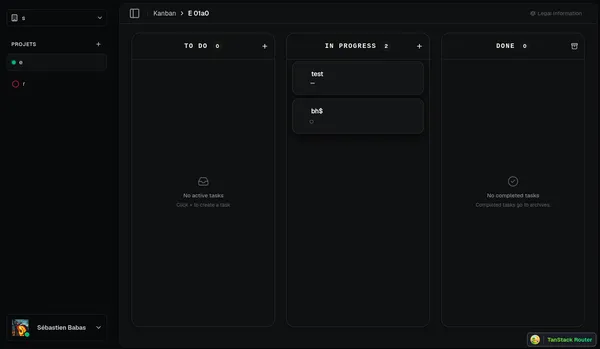
For now, this version of my project isn’t ready or functional enough yet to handle real, critical data in production.
My backend tech stack
Section titled “My backend tech stack”Here are the technologies I’ve added to Cloud NuxiPro:
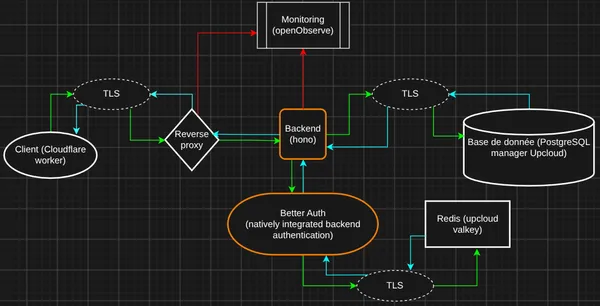
- Better Auth (for authentication)
- Drizzle (ORM for PostgreSQL)
- Hono (for the backend server)
- Fractional indexing (for managing task position on the Kanban board)
- Nginx (reverse proxy planned in front of the backend before Cloud NuxiPro launches)
- TypeScript (main backend language)
- Bun (runtime to run the backend)
- date-fns (for date handling)
- Zod / Hono validator (for validating incoming and outgoing data)
- OpenObserve (for centralized log management)
Why this choice for the backend?
Section titled “Why this choice for the backend?”I chose this stack to make NuxiPro efficient, predictable, and to guarantee resilient security. Since I’ll be storing my own data there, and I regularly see SaaS products get hacked, I refused to be next on that list. My goal is to build a system where users are safe thanks to a sovereign tool, hosted in Finland with UpCloud (sovereign, performant, and very appealing in terms of price).
I went with Hono and Better Auth because they’re simple to use, highly efficient, and help me build solid security.
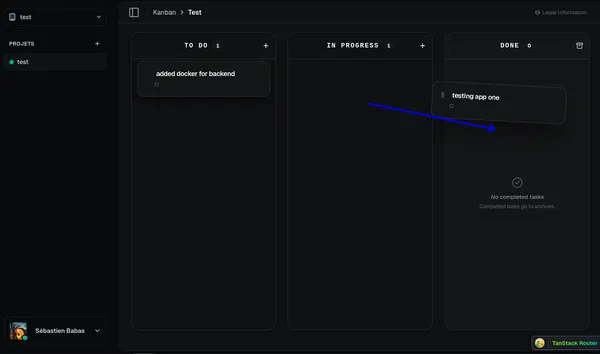
I also integrated Fractional indexing to manage card position on the Kanban board as efficiently as possible. It lets you drag and drop a task between two columns or above another one without having to rewrite the value of every other task. In short, it avoids collisions while keeping things smooth day to day.
To centralize my logs and handle errors, I use OpenObserve. The goal is to spot and fix crashes very quickly. Even before the Cloud version ships, I’m going to run a battery of intensive tests with the explicit goal of trying to crash the system. That will let me confirm it’s truly robust. Of course, that won’t rule out 100% of future bugs, but these crash tests will prove the tool’s solidity.
My frontend tech stack
Section titled “My frontend tech stack”- TypeScript (for simplicity and type safety)
- TanStack Router / Query (for handling dynamic pages and state)
- React (for building the user interface)
- Zod & React Hook Form (for validating form input data)
- shadcn/ui (so I don’t recreate the interface from scratch and waste time on pointless UI bugs)
- Tiptap (for building the Markdown editor)
- dnd kit (for smooth drag & drop in the Kanban board)
- Bun, Vite & Hono Client (for building, bundling, and communicating with the API)
Why this choice for the frontend?
Section titled “Why this choice for the frontend?”I chose this stack because it’s simple, maintainable over the long run, and built to last several years without becoming obsolete.
Why did I choose this overall stack?
Section titled “Why did I choose this overall stack?”I designed this stack mainly to build an efficient, simple daily work tool, free of unnecessary visual noise that wastes time.
My priority was (and still is) a tool suited to people who work solo. Nowadays, most software keeps piling on features instead of simplifying, which creates friction on a daily basis.
Being someone very demanding about security, performance, and freedom from bugs, I want my own work tool to be ultra-efficient and require zero energy to manage. NuxiPro is here to serve me every day, both in my professional and personal projects.